How do I send Ctrl-Alt-Delete via the MAC OSX RDP Client

Question How do I send Ctrl-Alt-Delete via the MAC OSX RDP Client ? Answer Use the following key combination, FN-CTRL-ALT-DELETE

Practical documentation and technical guides on network security, firewalls, Linux systems, monitoring, and automation.
We feature technical articles across the entire IT spectrum - Built from real-world experience and continuously updated.
Question How do I send Ctrl-Alt-Delete via the MAC OSX RDP Client ? Answer Use the following key combination, FN-CTRL-ALT-DELETE
Introduction There are 2 main methods for configuring the TCP stack on an ADX, globally or via a tcp profile. Within this article we will look at the main configuration settings available, such as how to configure Nagle, SACK and Window Scaling. TCP Profiles TCP profiles allow you to modify the TCP parameters on a … Read more

After compiling Python 2.7.5 you may find yourself being unable to to import sqlite3 and receiving the following error message, ImportError: No module named _sqlite3 Solution Install sqlite-devel via ‘yum install sqlite-devel’ Recompile Python. Note : Details on how to compile Python can be found within the following article.
Within v11.x of LTM/GTM BigIP certificates are located within a folder called ‘certificate_d’ under the necessary partition folder. i.e /config/filestore/files_d/Common_d/certificate_d By default everything is placed within the common partition folder ‘Common_d’. Below shows an example root@gtm:Active:Standalone] # ls -l /config/filestore/files_d/Common_d/certificate_d total 32 lrwxrwxrwx 1 root root 33 Sep 30 02:52 :Common:ca-bundle.crt_1 -> /config/ssl/ssl.crt/ca-bundle.crt lrwxrwxrwx 1 … Read more
TCL Background Unlike many programming languages (such as Python) TCL stores all values as strings. By using operators or commands these values can be interpreted as different data types (such as integers, binary etc). ‘eq’ vs ‘==’ Though, on the surface, the 2 TCL operators ‘eq’ and ‘==’ appear similar, ie both return a boolean … Read more
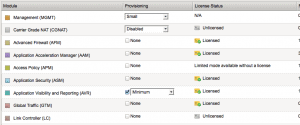
Summary Introduced within TMOS 11.0, AVR (Application Visibility and Reporting) allows you to gather statistics on the performance of applications, such as pool members, virtual servers etc. From within these statistics, analytics such as latency, response times and throughput (to name but a few) can then be viewed either via either the WebUI or the … Read more
Question How do I show the CPU usage for the management processor ? Answer To see the CPU usage on the MP (Management Processor) the following command is used, SSH@adx# show cpu-utilization peak: 41.4 percent busy at 5520 seconds ago 7243 sec avg: 10.3 percent busy 1 sec avg: 1.0 percent busy 5 … Read more

Purpose The purpose of this document is to explain the various steps required in configuring a remote access VPN on a Vyatta appliance. Vyatta Configuration The Vyatta configuration steps are pretty straight forward. You enable the outside interface with IPSEC, the IP pool, along with the secret passphrase and usernames and passwords, then your good … Read more
Purpose The purpose of this document is to explain the role and functions of the CSW Pseudo Stack. Summary Within the Brocade ADX feature set is the ability to forward traffic based on layer 7 attributes (such as host header, URI etc.). This is achieved by enabling content switching (CSW). In order for the the … Read more