Service Offload Configuration Commands 1. First configure the FPC/PIC (I believe on the SRX1400 if the NP-IOC is in slot 2 it would be FPC2 PIC0 but you can confirm) 2. Then setup a policy from zone x to zone y to allow whatever addressing/protocol and permit services-offload feature for that traffic 3. Then confirm … Read more
Within this article we will provide the necessary commands required to create a read-only account on a Juniper SRX. Within our example a user is created with the following attributes, A user with the username of ‘user1‘. ONLY allowed to use the show command. SNMP configuration is REMOVED from the configuration output. The policy-options and … Read more
Within this article we will provide the steps required to enable IPv6 on a Juniper SRX device. IPv6 Forwarding First of all we enable IPv6 forwarding. Once this is added you will need to reboot the device. set security forwarding-options family inet6 mode flow-based You can confirm that IPv6 forwarding is enabled once the device … Read more
The Juniper SRX provides an extensive set of options to block and prevent both internal and external based network attacks. Within this article we will look at the various options and settings to block, Sweeps – Horizontal scans, i.e scans across an IP range. Port Scans – Vertical scans, i.e scans across multiple ports on … Read more
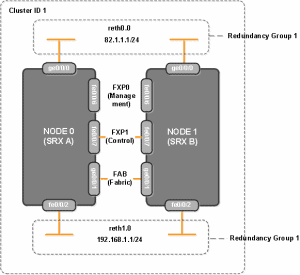
The Juniper SRX offers 4 types of High Availability (HA) deployment, Active/Passive Simple Active/Passive Full Mesh Active/Active Deployment Active/Passive Transparent Mode Within this article we will look at Active/Passive Simple upon a SRX 240 series device. Summary Active/Passive is the most common type of HA deployment and consists of 2 firewall members. Whilst one node … Read more
IEEE 802.3ad (LACP) is a technology that provides a method of aggregating multiple Ethernet links into a single logical channel. Configuration To configure LACP the following commands are used. This example aggregates the interfaces fe-0/0/3 and fe-0/0/4 into a logical interface named ‘ae1’. This logical interface is then configured as an access port and assigned … Read more
On the SRX Branch Series each interface can be configured as either layer 2 or layer 3. These are shown below : Routed Ports – Layer 3 (inet) Bridge – Layer 2 (only used for transparent mode) Ethernet-switching – Layer 2 (switchport) Within this article we will look at how to configure a trunk and … Read more
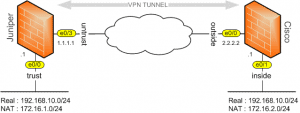
Purpose The purpose of this article is to describe the various steps required to create a site to site VPN between a Cisco ASA and a Juniper Netscreen when both sides have overlapping subnets. Example Within this example each side will have an endpoint of 192.168.10.0/24. Because of this both sides will present their endpoint … Read more
Purpose The purpose of this document is to explain the issues and problems surrounding the use of static NAT when using policy based VPN on a Juniper SRX Firewall. Background The issue, when using static NAT with a policy based VPN centres around how NAT is processed by the SRX, in that the Proxy ID`s … Read more
Below shows some of the main Juniper SRX commands available. All commands are provided with the necessary mode in which they should be run from. Configuration Commands replace pattern expr1 with expr # configuration mode find and replace string within configuration show | compare rollback {1..5} # configuration mode compare the current configuration against roll … Read more
Within this article we will look at the commands required for configuring a Site to Site VPN when one peer is using a dynamic IP address. Note : This article does not include the VPN configuration in its entirety only the additional/amended commands required for this scenario. There are 3 configuration settings that are defined. … Read more
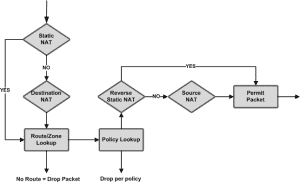
The Juniper SRX offers 3 main types of NAT. These are source, destination and static. In this article we will be providing explanations and configuration examples for each. Source NAT As the name suggests source NAT translates the source IP address. There are 2 main types of source NAT these are: Interface NAT – Traffic … Read more
Below shows the necessary steps/commands to create a route based VPN on a Juniper SRX series gateway. The main difference with a route based VPN is that a tunnel interface is created and assigned to your external interface. Any traffic that you wish to encrypt is routed to this tunnel interface. Access to and from … Read more
Within this tutorial we will be showing you how to configure Remote Access VPN (Dynamic VPN) on the Juniper SRX. IKE Configure Aggressive Mode set security ike policy ike-dyn-vpn-policy mode aggressive set security ike policy ike-dyn-vpn-policy proposal-set standard Define Preshared Key set security ike policy ike-dyn-vpn-policy pre-shared-key ascii-text <PRE-SHARED KEY> Configure the IKE Gateway Here … Read more
Below shows the necessary steps/commands to create a policy based VPN on a Juniper SRX series gateway. The main difference with a policy based VPN is that the tunnel action is defined within each security policy. Note : For troubleshooting steps please see here This VPN is configured with the following : Remote Endpoint : … Read more
Within this tutorial we will be providing the steps required to upgrade your Juniper SRX firewall. Copy Image First of all we copy the image over to the SRX via the use of scp. In this case I have used putty’s pscp. C:\Windows\System32>pscp “C:\Users\admin\Downloads\junos-srxsme-11.4R1.6-domestic.tgz” root@[SRX IP]:/mfs Confirm Hash Next we confirm that the file is … Read more
Below provides a short guide in configuring source NAT with an address pool on a Juniper SRX. The following example creates a pool with a 10.1.1.0/24 network. This pool of addresses are then used during the translation of source addresses. In addition to the pool we also configure the following options: set address-persistent – this … Read more
Within this article we show you the required steps for obtaining a packet capture on your SRX series firewall. Note : Great care should be taken when applying captures to ensure that only the traffic that you want to capture is defined within the firewall filter. This is to prevent any unnecessary load being placed … Read more
To create a range of ports within the SRX the following command is used. This example creates an application object named UDP-PORT-RANGE with a UDP port range of 5000-6999. set applications application UDP-PORT-RANGE protocol udp destination-port 5000-6999 Once created you can then add this to a group. This group can then be added to the necessary … Read more
Within this article the necessary steps required to configure PPPoE on the SRX platform are described. Note : This configuration is based upon a) the chap authentication method b) the outside/untrust interface being fe-0/0/7.0. Configuration Below shows the required configuration for PPPoE. set interfaces fe-0/0/7 unit 0 encapsulation ppp-over-ether set interfaces pp0 unit 0 ppp-options … Read more