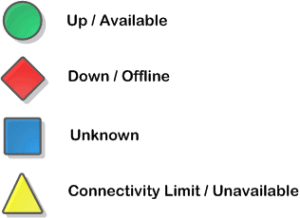
The following commands are based upon Brocade ADX 12.4. Show Commands show ip int show interface(s) ip`s show default values show defaults show server global show global configured parameters show ip vrrp-extended brief show cluster status show server real show real server stats show server real http [real server] show real server http details for … Read more
Below provides the steps rename a virtual server, pool or any other object within the configuration of a F5 LTM. The steps provided involve the editing of the (bigip.conf) configuration file. This file is then verified for any potential issues before it is loaded and committed to the F5 LTM`s running configuration. Backup Configuration First … Read more
The following commands are based upon F5 LTM 10.1.0 (and higher) bigpipe bigtop show statistic summary b self show show self IP`s b vlan show show vlans b interface show show interfaces b pool [pool name] show show pool b virtual [virtual name] show show vs b snat list list snats b route domain list … Read more
Symptoms Slow network performance when accessing back-end servers through a Cisco CSS running 8.20.3.03 (or higher). Background Cisco CSS 8.20.3.02 (and lower) did not support window scaling. This meant that the initial window scale option announced within the 3 way handshake was not propagated to the server. This issue was resolved within 8.20.3.03 (CSCsk92868), however … Read more
Via the use of administrative states, the administrator has the power to gracefully select a pool members state. States There are 3 administrative states: Enabled – This is the default state. All connection types are passed to the pool member and the monitor continues to determine the state of the member.Disabled – Only new connections … Read more
What is an iRule ? iRules are built using a TCL-based scripting language allowing arbitrary manipulation of traffic flowing through the BIG-IP, including real-time modification of defined data. Components of an iRule A typical iRule contains four main components. These are : rule NAME { when EVENT { if { conditional_statement } { action_when_condition_true } … Read more
Below shows a number of iRule examples that you may find useful when creating or deploying iRules on the BIGIP F5 device. For the latest in iRule tips and tricks hop over to our iRule Cookbook – click here WWW redirect This simple iRule redirects any HTTP traffic without the prepending www to a www … Read more
A monitor is a test that the LTM can perform on either a node of member. A monitor typically tests for a specific response within a specified time period. BigIP uses the results of this to decide on whether traffic should be sent to the node or pool member. Types of Monitoring There 4 main … Read more
Introduction The BigIP F5 provide 2 ways in which SSL is processed. These are : Client SSL – F5 decrypts the encrypted traffic inbound from the client.Server SSL – Traffic is re-encrypted by the F5 then routed onto the backend servers. There are a number of advantages to SSL termination on the F5, which are … Read more
Persistence When an application maintains the session, a persistent session between the client and server must be correctly maintained to ensure the server can continue to process client requests. A typical example is web based shopping carts, this normally requires the user to maintain persistence to a single server during the lifetime of the session. … Read more
The BigIP F5 LTM supports various load balancing methods. These methods are categorized as either Static or Dynamic. Dynamic load balancing methods are considered balancing methods that take the server performance into consideration.This article also explains how the BigIP F5 LTM can balance traffic outside of the fore-mentioned Static and Dynamic balancing methods. Static Round … Read more
A sorry server provides HA (Primary/Secondary) based balancing for your backend servers. This allows traffic to only route to the sorry server in the event of the primary service becoming unreachable. Below details the configuration. This example sets server 1 as the primary server and server 2 as the secondary server. Configure Services service server1 … Read more
Big IP`s F5 LTM offers 2 types of NAT. These are SNAT and NAT. SNAT (Secure Network Address Translation) provides source NAT. The SNAT option ‘Automap’ enables source NAT`ing (SNAT) based on the IP address of the egress interface. NAT (Network Address Translation) – NAT provides a static one to one NAT translation. Configuring SNAT … Read more