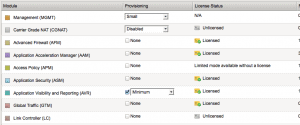
Summary Introduced within TMOS 11.0, AVR (Application Visibility and Reporting) allows you to gather statistics on the performance of applications, such as pool members, virtual servers etc. From within these statistics, analytics such as latency, response times and throughput (to name but a few) can then be viewed either via either the WebUI or the … Read more
Purpose The purpose of this document is to explain the various steps required in configuring a remote access VPN on a Vyatta appliance. Vyatta Configuration The Vyatta configuration steps are pretty straight forward. You enable the outside interface with IPSEC, the IP pool, along with the secret passphrase and usernames and passwords, then your good … Read more
Purpose The purpose of this document is to explain the role and functions of the CSW Pseudo Stack. Summary Within the Brocade ADX feature set is the ability to forward traffic based on layer 7 attributes (such as host header, URI etc.). This is achieved by enabling content switching (CSW). In order for the the … Read more
Question How do I show the CPU usage for the management processor ? Answer To see the CPU usage on the MP (Management Processor) the following command is used, SSH@adx# show cpu-utilization peak: 41.4 percent busy at 5520 seconds ago 7243 sec avg: 10.3 percent busy 1 sec avg: 1.0 percent busy 5 … Read more
Problem When using the command “persist uie add” in conjunction with the “node” command within an iRule the F5 issues a RST back to both the client and server. Background Lets look at an example. First we`ll look at the configuration and then the resulting behaviour. Configuration You have the following configured, You have persistence … Read more
Introduction Within this article we will look at the various way to configure NAT on a Vyatta appliance. To configure NAT source and destination rules are defined using the ‘set nat source’ and ‘set nat destination’ commands. The source rules relate to the translation of the source address, and the destination rules relate to the … Read more
Content-Length The content-length header informs the client of the byte length of the HTTP body. This is typically used for HTTP 1.1 (i.e persistent connections) to ensure the client knows when the current response/request is complete so that the connection can be reused for further requests. Transfer-Encoding Chunked However in certain cirucumstances the server may … Read more
The auto last hop feature ensures that traffic is sent back via the same hop from which it was sent. This is done by the F5 forwarding traffic to the MAC address of the last hop. The last hop MAC address is recorded within the connection table along with the source and destination addresses.
Background The Brocade ADX offers 3 main types of layer 7 healthchecks. These are, Server Healthcheck – Server healthchecks are configured on the real server itself. Once configured it issues a healtcheck to the real server based on the port/protocol configured. Port-Policy – A port-policy is a policy that contains all of your parameters for … Read more
After finding this funky little command the other day I thought the readers of Fir3net may find it useful. Its especially handy when your LTM/GTM is placed directly onto the public network i.e not behind a firewall. Command To restrict access to the Web UI the following command is used, root@f5ltm1(Active)(tmos)# modify sys httpd allow … Read more
The Vary Header The vary header is sent within the servers response to the client and instructs any intermediary caches to cache a separate instance based on the headers specified within the vary header. Encoding Headers As our example is based around the following HTTP headers, here is a quick summary of each, Content-Encoding (HTTP … Read more
The F5 offers a number of different ways to you can represent your data via iRules such as variables, tables, datagroups and arrays. Within this article we will look at the variables. There are 2 main types of variables, local and global. Local Local variables represent data within your local namespace, and are assigned the … Read more
Introduction RAM Cache is a feature that provides the ability to serve content to your clients directly from the memory of your F5 appliance. This benefits both client and server by reducing response latency and also server load. What is Cached ? Heres a summary, The following items are cached, All 200, 203, 206, 300, … Read more
Issue When viewing the UIE persistence records you observe that the Client Addr field is not populated. root@f5ltm(Active)(tmos)# show ltm persistence persist-records all-properties Sys::Persistent Connections universal – 172.16.100.200:80 – 192.168.1.31:80 ———————————————————– TMM 0 Mode universal Key 8ffa6c0012825a76b3b68d10a9c68ad3 Age (sec.) 4 Virtual Name VS-172.16.100.200-80 Virtual Addr 172.16.100.200:80 Node Addr 192.168.1.31:80 Pool Name POOL-172.16.100.200-80 Client Addr :: … Read more
TACACS+ accounting was first supported within BIG-IP version 10.2.0. Within this article we will show your the commands required to enable this feature. Configure First of all you will need to enable accounting within your authentication settings (this can be found within the GUI under ‘System / Users / Authentication’) modify sys db config.auditing.forward.destination value … Read more
Within this article we will show you how to list all IP`s relating to a single AS. STEPS First of all get the IP address for the domain. [root@server]$ whois 173.252.110.27 | grep OriginAS OriginAS: AS32934 Finally run another whois against the AS to obtain a list of IPs. origin=$(whois `dig facebook.com +short | head … Read more
How can I optimize the throughput of a VPN across a WAN based link ? I was recently asked this question the other day by a client, after seeing the results (in which the transfer speeds were nearly tripled) I thought it would make an interesting article. Background My client had a VPN (Site to … Read more
Issue When trying to access the GUI you may observe the following error, Username or password is incorrect.Failed to parse server data. Solution This is due to a bug with VSE 6.5 R2. Which is caused by the Vyatta Appliance not having an interface named ‘eth0’ present. To resolve this, Edit the file ’/config/config.boot’ via … Read more
The Brocade ADX offers two methods for binding multiple ports to a single healthcheck ; via the use of a port profile or by using healthcheck element groups. The main caveat when using a port profile is that you can only bind a non well-known port to the healthcheck of a well known port. And … Read more
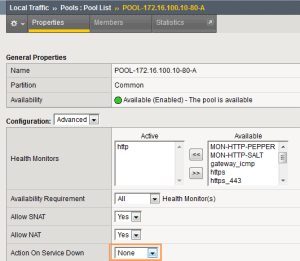
Background “Action on Service Down” defines the action that should be taken once the pool member has been marked as “down” by the associated healthcheck, after it has been selected as the load balancing target for a connection. Configuration To configure “Action on Service Down” goto the GUI and then to ‘Local Traffic / Pools’. … Read more